Public awareness
Make one approved issue visible. Point people to your organisation’s information so a short street interaction can lead to a fuller explanation.
Advertising bikes, human billboards and street teams for charity awareness, environmental messages and animal welfare campaigns. Bring an approved message into the places relevant to your activity.
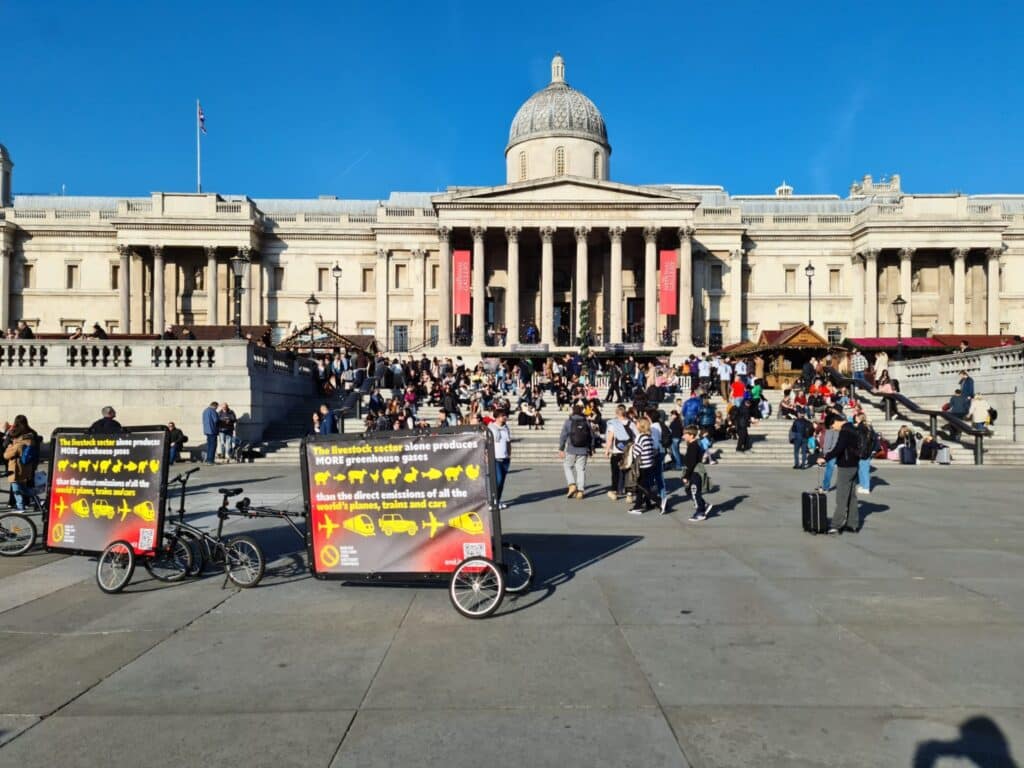
Our historical portfolio includes Greenpeace. Our public gallery also records Compassion in World Farming animal welfare creative and Cancer Research UK event promotion. A cause-led brief needs a clear public action, accurate claims and a plan for how the team will engage.
Portfolio relationships are historical; the photograph above shows Compassion in World Farming creative. Greenpeace is a separate portfolio relationship.
Make one approved issue visible. Point people to your organisation’s information so a short street interaction can lead to a fuller explanation.
Plan around the event, locations and operating window. Specify visible displays, information distribution or trained conversations as distinct tasks.
Invite event attendance, a campaign-page visit or another approved action. Fundraising, sign-ups and personal-data collection need a separately agreed process.
Poster bikes carry creative through agreed streets. Human billboards provide an on-foot display. Promotional teams can share approved material or direct questions to the organisation where that role is included.
Define what staff may say, how to handle questions outside the brief and who is available for escalation. Accurate content and respectful interaction matter as much as the display. Agree photography and avoid unnecessarily capturing identifiable members of the public.
Share locations, event context, dates and any venue or landowner conditions. Access is checked for each brief. A mobile format does not grant a right to operate in every pedestrian area or outside every building.
A pedal-powered bicycle has no engine exhaust while being pedalled. A reusable frame can support further campaigns, and suitable print may be reused when its message and condition allow. Ask about available electric-assisted configurations where useful for the route.
This does not make a campaign zero-carbon. Transport, electricity, print production, materials and end-of-life handling also matter. Agree the operating plan and minimise unnecessary journeys and production where practical. Only make quantified environmental claims when supporting evidence exists.
Separate delivery evidence—staffed hours, locations and photographs—from visits, registrations, donations or other responses recorded by your organisation. A photograph shows presence; it does not measure changes in public opinion or policy.
These are part of our historical portfolio. Share the organisation, message, location and required activity so the current scope can be assessed.
No such claim is made. Bicycle operation is one part of delivery; transport, energy and materials also need accounting before any carbon claim.
Do not assume this is included. It needs a separate role, handling process and required approvals. Displays can instead direct people to your own channels.
Agree delivery records in advance. Claims about supporters, donations or broader impact require their own data and method.
Share your dates, locations and budget for a relevant quote. A standard charity discount is not assumed or advertised without confirmation.