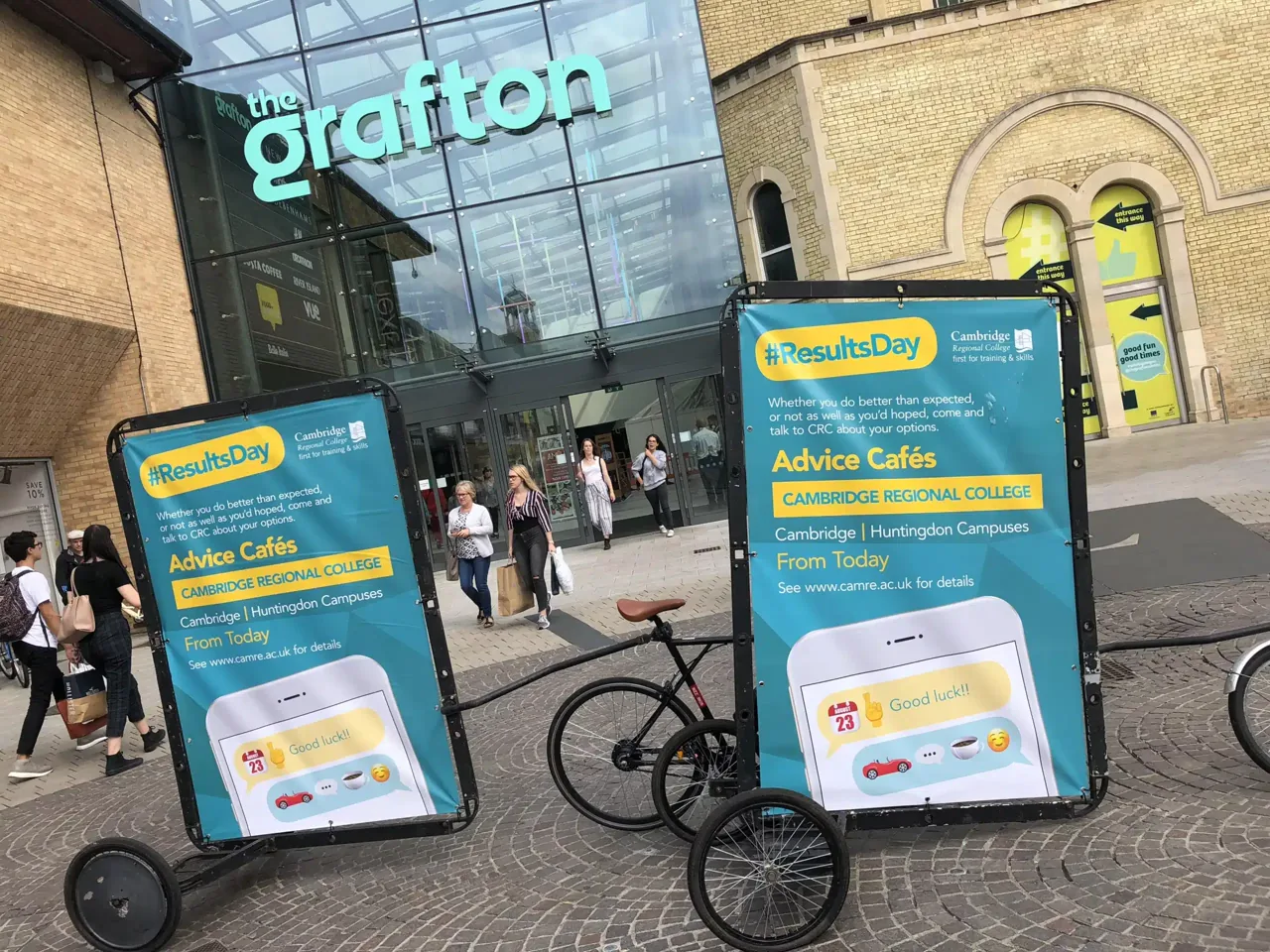
Cambridge Regional College
15 operated ad bikes per day, with a different local plan for each of two days.
Read the campaign storyPoster and LED advertising bikes carry your message through relevant streets and locations. Compare operating packages, print preparation and availability for your dates.
London & nationwide · Poster and LED campaigns
The same operating base for both formats. Compare the Central London three-hour session, six-hour day and other packages below. All operating prices are per bike, excluding VAT.
Poster print costs extra. Preparation, urgency fees and availability differ by display. These are operating prices, not an all-inclusive production total.
| Package | Operating price per bike, excluding VAT |
|---|---|
| Three-hour session | £295 |
| Four-hour session | £349 |
| Six-hour day | £395 |
| Event day | £500 |
| Seven-day campaign | £2,500 |
| Package | Operating price per bike, excluding VAT |
|---|---|
| Campaign day | £500 + transport |
| Seven-day campaign | £3,500 + transport |
Event-day, seven-day and outside-London operating hours are set out in your quote. Confirm the itinerary, locations and any overnight arrangements before booking.
Poster printing is charged separately. Allow at least five working days for preparation in normal circumstances. An approximately three-working-day turnaround may sometimes be possible with an urgency fee, quoted separately, only after feasibility is confirmed. It is not guaranteed.
Print quantity, fitting and any reusable artwork or existing banners are specified in the quote.
Plan a poster campaignOnly a very small number of LED bikes is available. Availability must be confirmed for your requested dates. LED has no poster printing charge or poster printing lead time; artwork adaptation, approval, playback requirements and any production charges are confirmed for your campaign.
Check LED availabilityA rider, artwork checks, GPS tracking and campaign proof photographs. Transport within the M25 is included. Design, artwork adaptation or video production, additional campaign tasks and other extras are identified separately in your quote.
One transport fee per campaign: £250 for 25–75 miles, £400 for 75–150 miles, or £600 for 150+ miles. The quote confirms the starting point, applicable band and how it relates to the included M25 area. Required crew overnight stays are charged at cost.
Tell us your preferred campaign date and artwork status when enquiring. Rush poster requests need a separate feasibility check and urgency-fee quote. There is no same-day deployment promise.
Severe-weather interruptions can be rescheduled or credited for affected activity, with operational decisions and arrangements confirmed for the booking.
Electric assistance describes propulsion. An e-bike does not automatically carry an LED screen. These package rates apply to operated ad bike campaigns, not DIY hire, equipment purchases, human billboards or digital ad vans.
An advertising bike combines a bicycle or electric-assisted bicycle with a printed poster or LED advertising display. Plan the route, people and materials around the action you want someone to take.
Electric assistance describes the bicycle’s power; it does not automatically mean the display is digital. Confirm the exact configuration for your dates.
Compare bikes, human billboards and promotional staff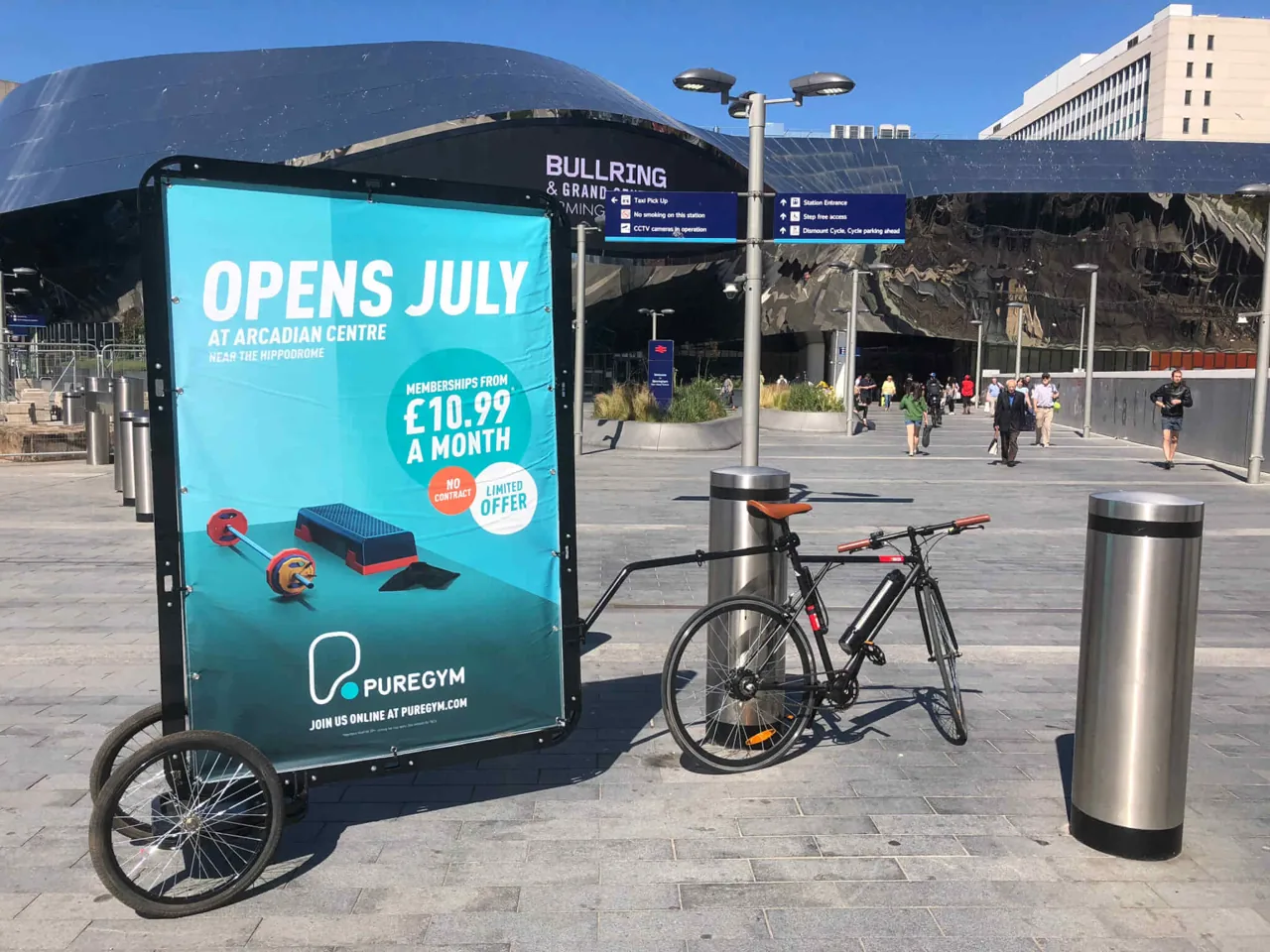
Choose a managed campaign when you need the advertising activity operated for you. Ask about DIY hire when you have people to run a temporary campaign. Buying equipment is a different decision: you keep the kit and take responsibility for operating it whenever you use it.
The useful comparison is the complete job, including people, print and logistics. A trailer price and a campaign price cover different things.
On a small screen, scroll the table sideways to compare every column.
| Decision | Managed campaign | DIY hire | Buy equipment |
|---|---|---|---|
| What are you arranging? | Advertising activity with the agreed equipment and operating team | Temporary use of an agreed kit | Ownership of the specified equipment |
| Who operates it? | The team named in your campaign agreement | Your organisation or your appointed team | Your organisation or your appointed team |
| What needs confirming? | Dates, locations, hours, riders, artwork, transport and reporting | Kit contents, compatibility, collection or delivery, hire period and return arrangements | Components, compatibility, delivery, storage and ongoing maintenance |
| How is print handled? | Agree production, fitting and any changes in the quote | Confirm whether print and fitting are included | Specify the initial graphics and ask about replacement prints |
| Who plans the activity? | Agree the planning responsibilities with the operator | Your team plans the deployment | Your team plans each deployment |
| What happens afterwards? | Receive the reporting agreed before the campaign | Return the hired kit under the agreed terms | Retain the equipment for future use |
A managed campaign can suit a college promotion, shop opening or local awareness campaign where your own team has other work to do. Start with the places and times that matter, then agree the number of bikes and the tasks for the people operating them. If you need leaflet distribution or conversations as well as a moving display, describe those tasks explicitly.
The Bike Ads’ history includes operated campaigns for colleges, gyms and other local advertisers. Cambridge Regional College’s August 2019 activity, for example, used a planned multi-bike deployment over two days. The service involved running the campaign, rather than simply supplying a trailer.
DIY hire can suit an organisation that already has people available to operate the equipment. It still requires preparation: identify who will transport, assemble, check, store and return the kit, and who will oversee the activity on each day.
The Bike Ads’ historical UCL work included DIY hire of an advertising-bike kit and bicycle with print. That is a different service from a campaign supplied with riders. For a new enquiry, ask which kit is available for your dates and check the current contents and responsibilities in writing.
Buying may be worth considering when your team expects to use the equipment repeatedly and can manage storage, transport and operation. Compare the purchase and replacement-print costs with the full cost of running each outing. Ownership alone does not provide a campaign team or a route plan.
For equipment enquiries, specify whether you need a complete setup or replacement parts and graphics. Include a photograph or model details when asking about print for equipment you already own.
Yes—the first question is who will operate the activity. Tell us whether your agency needs an operated campaign for an advertiser, temporary equipment for your own staffing team, or equipment to keep. Identify the artwork approver and the person who will sign off the scope.
There is no useful answer without the scope. Compare the same dates, operating hours, people, equipment, print and transport. DIY and ownership leave operating tasks with your team; include those costs when making the decision.
Tell us what you want to run and whether you need an operating team, temporary equipment or a purchase. If you are unsure, describe the activity and the people you already have available.
The cost depends on the number of bikes, operating hours, dates, locations, artwork and logistics. Request a quote for the complete campaign so you can see what is included and what would be charged separately.
Poster and LED campaigns share the same operating base, with three-hour sessions and six-hour days in Central London, excluding VAT. Compare all published packages and transport charges. Poster printing costs extra; any urgency fee and additional production are quoted separately.
A price described simply as “per day” is not enough to compare offers. Check how many operating hours it covers, whether riders are included and how the equipment and printed material reach the campaign location.
On a small screen, scroll the table sideways to compare every column.
| Item | What the quote needs to make clear |
|---|---|
| Equipment and format | Number of units and the actual display configuration |
| People | Riders and any additional promotional staff, with their agreed tasks |
| Time | Dates, operating hours, breaks, setup and any extra-hour charges |
| Artwork and print | Who supplies the design; production, fitting and replacement graphics |
| Transport | Delivery, collection, transfers between locations and any accommodation |
| Planning | Route preparation, site coordination and the responsibilities of each party |
| Reporting | What records and photographs will be supplied, and when |
| Tax and terms | VAT treatment, payment schedule, quote validity and cancellation or change terms |
More equipment or operating days changes the amount of staff time and production required. Several locations may add transport or overnight arrangements. Different artwork for each branch creates a different print requirement from using one design throughout.
Timing matters too. A fixed launch date leaves less flexibility than a choice of weekends. Send the dates early, especially if artwork, materials or location arrangements still need to be completed. Availability and production deadlines need confirmation for the specific booking.
Poster printing is not included in the operating base. Allow at least five working days for normal preparation. An approximately three-working-day turnaround may sometimes be possible with an additional urgency fee, only after feasibility is confirmed; it is not guaranteed. The print and urgency amounts are quoted separately.
LED does not have the poster print charge or poster print lead time. We have very few LED bikes, so dates require an availability check. Artwork adaptation, approval, playback requirements and production charges are confirmed for the specific campaign.
Check the written quote. Identify whether you already have usable artwork, need new printed panels or want to reuse existing graphics. If you plan to change an offer during the campaign, include each version and its changeover date in the brief.
Artwork approval and design creation are different tasks. Ask for the specification for the equipment being booked before commissioning the final files.
A managed campaign and DIY equipment hire have different scopes. State which you need. For an operated campaign, confirm the riders, hours and duties. For DIY, confirm the kit contents and your team’s responsibilities for operation, transport and return. Compare the delivery options.
Ask for the whole schedule to be priced. Some costs may be shared across several days, while staffing and location requirements still apply. A multi-day quote is specific to its scope; a discount should not be assumed before it is offered.
Agree how interruptions, route changes, postponements and cancellations will be handled before booking. Ask who can approve a change during the campaign and how additional costs, if any, are authorised. The terms for one campaign should not be assumed to apply to another.
Choose poster or LED and share your preferred start date, artwork status and any existing print. Identify a rush poster request explicitly. There is no same-day deployment promise; an enquiry does not reserve a scarce LED bike. Electric assistance refers to propulsion and does not automatically mean an LED display.
Send the city or postcodes, preferred dates, campaign objective and the locations that matter most. Tell us which format you have in mind—or describe the task if you are unsure. Add the proposed operating hours, number of units if known, artwork status and any leaflet or staffing requirement. A budget range is useful if you have one.
If you are booking for an advertiser, identify the brand, the agency’s role and who approves the scope and artwork. You do not need a finished route plan to start the conversation.
Before confirming a booking, check that the written scope covers the dates, people, equipment, logistics, reporting, price and terms you have agreed. An enquiry starts that process; it does not by itself confirm availability or reserve the campaign.
A useful brief explains who the campaign is for, where those people are likely to be and what they should do next. “Promote our opening on Saturday” gives the team a clearer starting point than “cover the city”. Add the location, timing, approved message and destination for enquiries.
Choose a main action: find a new store, visit an information event, look at available rooms or read an approved public-information page. Make the destination usable on a phone and keep the information consistent with the artwork.
Decide how you will recognise a response before the campaign runs. A dedicated landing page, offer code or enquiry-source question may help, depending on the campaign. Each records a different part of the response and has limits.
Share priority postcodes, entrances, event times and any known access requirements. Agree a workable route and alternatives if a location becomes unsuitable. Being near a venue does not automatically give a team permission to operate inside it.
Name the person who can make decisions during the campaign. For work across several locations, use a location schedule with the relevant artwork and instructions for each team. If there are bikes, human billboards and promotional staff, give each role its own tasks.
Use the specification for the actual equipment booked. Check the headline, location, date, offer and next step, and confirm who gives final approval. A proof should be checked for factual accuracy as well as appearance.
If the team will distribute leaflets, agree who supplies them, where they are handed over, how remaining stock is handled and whether distribution counts are required. Confirm any briefing or approved answers for staff who will speak to the public.
Set out how weather, access restrictions, late materials or timing changes will be escalated. Agree who can authorise a different location or schedule, and record material changes so the final report reflects what happened.
Ask for the reporting you need when requesting the quote. The format, detail and delivery date should be agreed as part of the scope, especially if an agency needs material for its own client report.
Delivery, estimated audience and commercial response answer different questions. Keep them separate when reviewing a campaign.
On a small screen, scroll the table sideways to compare every column.
| Question | Useful record | What it tells you |
|---|---|---|
| Did the agreed activity take place? | Dates, operating hours, locations, team or equipment records and photographs | Delivery against the agreed scope, including changes |
| How much material was distributed? | Counts recorded using an agreed method | Distribution activity; not necessarily readers or unique people |
| How many people may have been exposed? | An audience estimate with its source, period and assumptions | An estimate, rather than a count of everyone who saw the display |
| Did people take the next step? | Tagged visits, code use, enquiries or registrations | Recorded responses through those routes, with attribution limits |
| Did the campaign achieve a business result? | The advertiser’s qualified enquiries, bookings or sales data | Commercial outcomes that need interpreting alongside other activity |
A photograph can show the creative, equipment and location at a particular moment. It does not establish how many people noticed the message across a whole shift. Likewise, footfall in a street is not the number of people who saw or remembered an advert.
A useful report explains material differences between the booked plan and actual activity: a revised location, changed hours or an interruption. This makes it easier to evaluate delivery and improve the next brief. Do not treat the initial booking schedule as the final record automatically.
Use consistent dates and definitions when comparing enquiries, visits or sales. Where other advertising ran at the same time, a change in results cannot automatically be attributed to the bikes. Report small totals as numbers as well as percentages.
The Bike Ads’ historical college and local campaigns include campaign reports and photographs. Discuss which reporting is appropriate for your new brief and have it included in the agreed scope.
Plan your campaign and reporting. Send the objective, locations, dates and the evidence your team needs afterwards.
Campaign experience since 2014, from local gym messages to coordinated college activity. Explore the brief, delivery and lessons behind these examples.
15 operated ad bikes per day, with a different local plan for each of two days.
Read the campaign story
Colindale opening creative and the planning behind a local club message.
Read the campaign story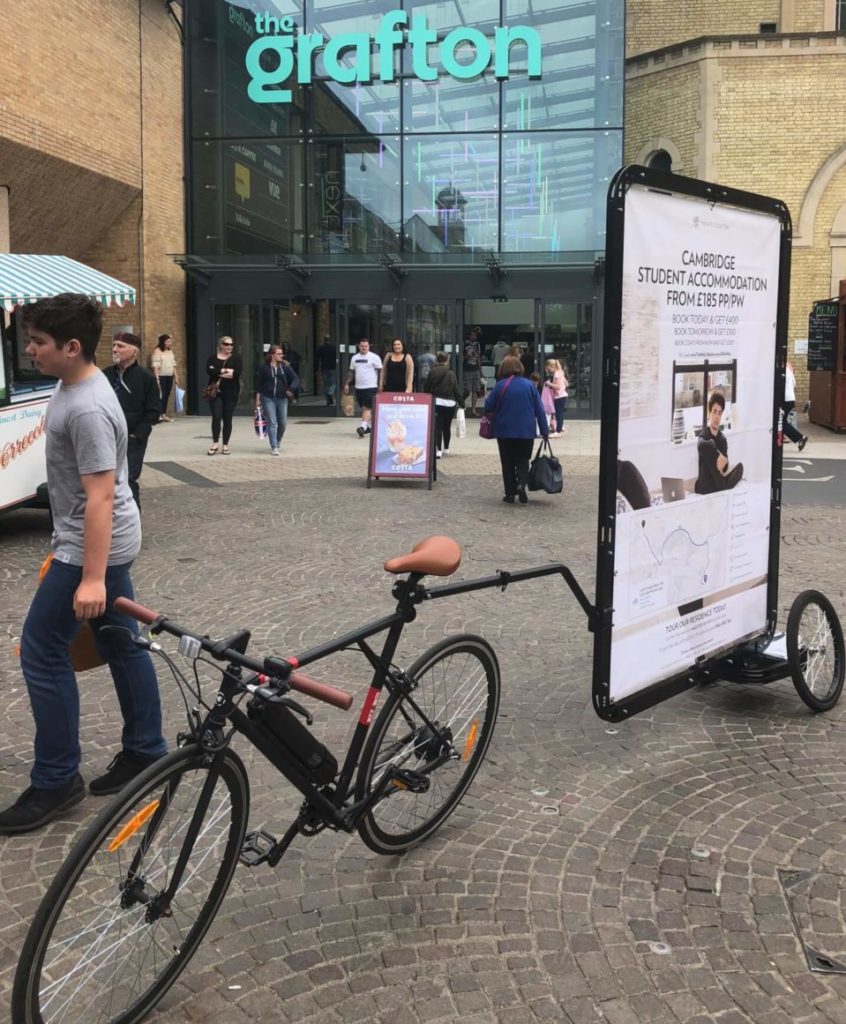
One staffed bike bringing an accommodation message into Cambridge student areas.
Read the campaign storyOne operated bike and one member of promotional staff, each with a defined role.
Read the campaign storyPhotographs show the wider campaign archive; each case identifies the context of its imagery.
Yes. The published operating base applies to both. Poster print is extra; any urgency fee, production extras and transport outside the included area are specified separately. LED dates depend on limited availability.
Access depends on the location, landowner, route conditions and local requirements. Routes and permissions must be checked for the specific activity.
Poster printing is charged separately. Allow at least five working days for preparation in normal circumstances. An approximately three-working-day turnaround may sometimes be possible with an urgency fee, quoted separately, only after feasibility is confirmed. It is not guaranteed. Only a very small number of LED bikes is available. Availability must be confirmed for your requested dates. LED has no poster printing charge or poster printing lead time; artwork adaptation, approval, playback requirements and any production charges are confirmed for your campaign.